
Marmulán (Sideroxylon)
Sideroxylon canariensis Banks ex Lowe. · Family: Sapotaceae
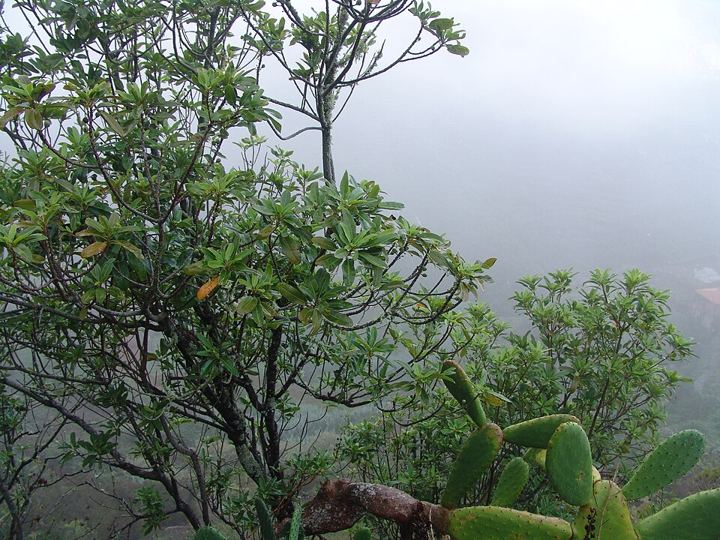
An uncommon species scattered on cliffs and ravine slopes of the middle zone, in thermophilous woodland and dry laurel forest.
Where it grows on Tenerife
Grows in: South coast · North coast · South, 300–1000 m · North, 300–1000 m
Zones are derived approximately from the Cabildo belts.
Description
Evergreen tree 8-12 m tall, with thick branches and dark grey, fissured or cracked bark that exudes a whitish sap if cut. Leaves simple, alternate, lanceolate, 10-15 cm long. Flowers whitish, clustered in the leaf axils. Fruits fleshy, subglobose, black when ripe. Flowers in winter.
Propagation and growing
The edible fruits of this small, rare tree are dark and fleshy and contain a hard seed like a small nut, which germinates with difficulty and irregularly. The germinated seedling develops poorly and is highly susceptible to attack by nematodes and subsequent infection by fungi of the genus Fusarium, which delay and impair the plant's growth and often kill it. These diseases can be successfully controlled by growing in sterile peat and treating with benomyl in case of infection. All of this may explain its scarcity in the wild. It is very rarely available in nurseries. It is an extremely slow-growing plant and only after two or three years in cultivation can it reach half a metre tall.
Garden use
This beautiful small tree, which can sometimes reach 8 metres tall, has high ornamental value. Its rarity and scarcity give it outstanding conservation value, and in our view its use and cultivation should become widespread as one more means of ensuring the survival of this interesting relict species.
Notes
Marmolán is one of the most interesting examples of Macaronesian flora dating back to the Tertiary. It can be considered one of the rarest species in the flora of the Canary Islands, and it also grows in the Cape Verde islands and Madeira.
Protection status
Removed from the Canary Catalogue of Protected Species in 2009 and re-listed in Annex IV (special protection) in 2014 (Decree 20/2014). Also on the Spanish List of Wild Species under Special Protection.
Potential vegetation
Junipero-Oleetum cerasiformis; Visneo-Arbutetum canariensis.
Source: Cabildo de Tenerife, “Guía de especies vegetales”, CC BY. Translated from Spanish by us.
Bioclimatic belts
Warm coastal belt
- Inframediterranean, semi-arid (upper level)
- Inframediterranean, dry, without trade-wind fog
- Inframediterranean, dry, with trade-wind fog
Warm mid-slope belt
- Thermomediterranean, semi-arid (lower level)
- Thermomediterranean, semi-arid (upper level), without trade-wind fog
- Thermomediterranean, semi-arid (upper level), with trade-wind fog
- Thermomediterranean, dry, with trade-wind fog
- Thermomediterranean, dry (lower level), without trade-wind fog
Districts
Anaga · Metropolitan area (Santa Cruz and La Laguna) · Acentejo · La Orotava Valley · Daute · Teno · South-west · Abona · South-east · Güímar Valley