
Sow-thistle (Sonchus congestus)
Sonchus congestus Willd. · Family: Asteraceae
Cliffs, mainly in the forest zone; on Tenerife's northern slope found at 150–800 m.
Where it grows on Tenerife
Grows in: South coast · North coast · South, 300–1000 m · North, 300–1000 m
Zones are derived approximately from the Cabildo belts.
Photos
From Wikipedia
Sonchus congestus is a species of flowering plant in the family Asteraceae. It is endemic to the Canary Islands (Gran Canaria, Tenerife and Lanzarote).
Text from Wikipedia, CC BY-SA 4.0: Sonchus congestus
Description
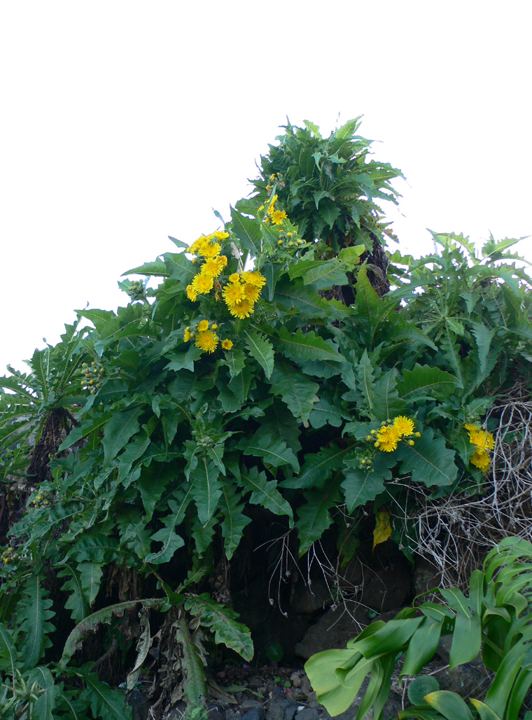
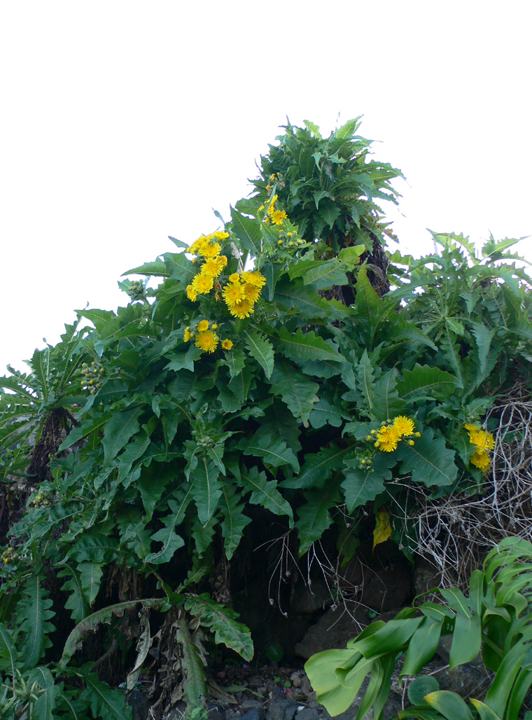
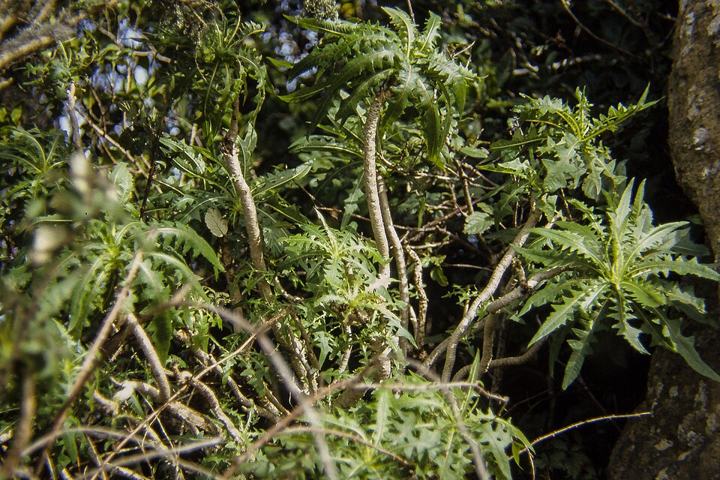
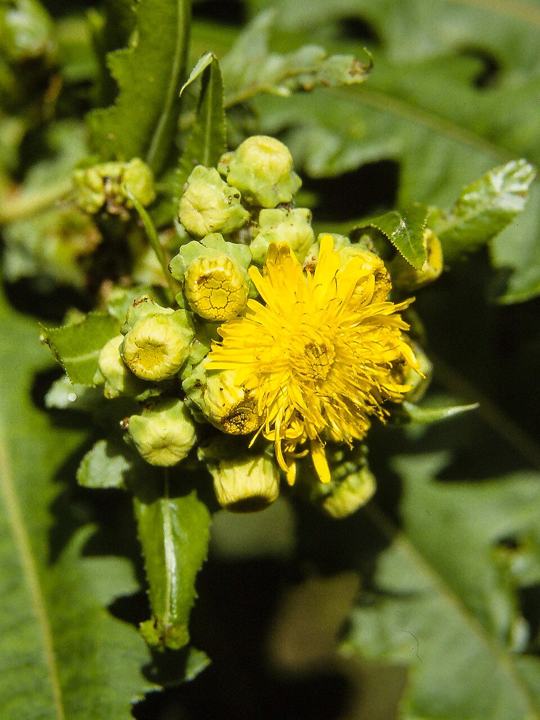
Branched shrub up to 1.5 m tall. Leaves lanceolate, divided, with acuminate lobes with serrated edges. Dense inflorescence with many tomentose heads of yellow flowers, 2–2.5 cm across. Flowers in winter and spring.
Propagation and growing
The fruits of this shrub are achenes with a pappus of hairs that aids wind dispersal. The seeds, mixed with soil and sown in seed trays, germinate easily and quickly (from the first week). The plants are vigorous and undemanding as to soil, needing moderate but regular watering and a sunny position. It is not usually available in nurseries, but it can be ordered 5 or 6 months in advance.
Garden use
This shrub, 1.5 m tall, simple or more usually much-branched, with short branches ending in large rosettes, flowers abundantly in winter and spring with large, showy, bright yellow heads grouped in dense inflorescences. It is a cliff-dwelling species but also thrives on steep slopes, across a wide altitudinal range (150–1000 m above sea level). It is an excellent species for gardens recreating rocky cliff habitats, banks and steeply sloping ground; but it can also be used in other kinds of garden, always with wide plant spacing.
Notes
Within its natural range, it is recommended for environmental restoration work.
Protection status
Not listed.
Potential vegetation
Periploco-Euphorbietum canariensis; Junipero-Oleetum cerasiformis; Visneo-Arbutetum canariensis; Lauro-Perseetum indicae.
Source: Cabildo de Tenerife, “Guía de especies vegetales”, CC BY. Translated from Spanish by us.
Bioclimatic belts
Warm coastal belt
- Inframediterranean, semi-arid (lower level)
- Inframediterranean, semi-arid (upper level)
- Inframediterranean, dry, without trade-wind fog
- Inframediterranean, dry, with trade-wind fog
Warm mid-slope belt
- Thermomediterranean, semi-arid (lower level)
- Thermomediterranean, semi-arid (upper level), without trade-wind fog
- Thermomediterranean, semi-arid (upper level), with trade-wind fog
- Thermomediterranean, dry, with trade-wind fog
- Thermomediterranean, dry (lower level), without trade-wind fog
- Thermomediterranean, subhumid, with trade-wind fog
- Thermomediterranean, humid, with trade-wind fog
Districts
Anaga · Metropolitan area (Santa Cruz and La Laguna) · Acentejo · La Orotava Valley · Daute · Teno · Abona · South-east · Güímar Valley