
African tulip tree
Spathodea campanulata Bauv. · Family: Bignoniaceae
A tropical species of warm savannas. Drought resistant; needs full sun to flower well. Adapts to different soils, growing fastest in rich soil with plenty of water.
Where it grows on Tenerife
Grows in: South coast · North coast · South, 300–1000 m
Zones are derived approximately from the Cabildo belts.
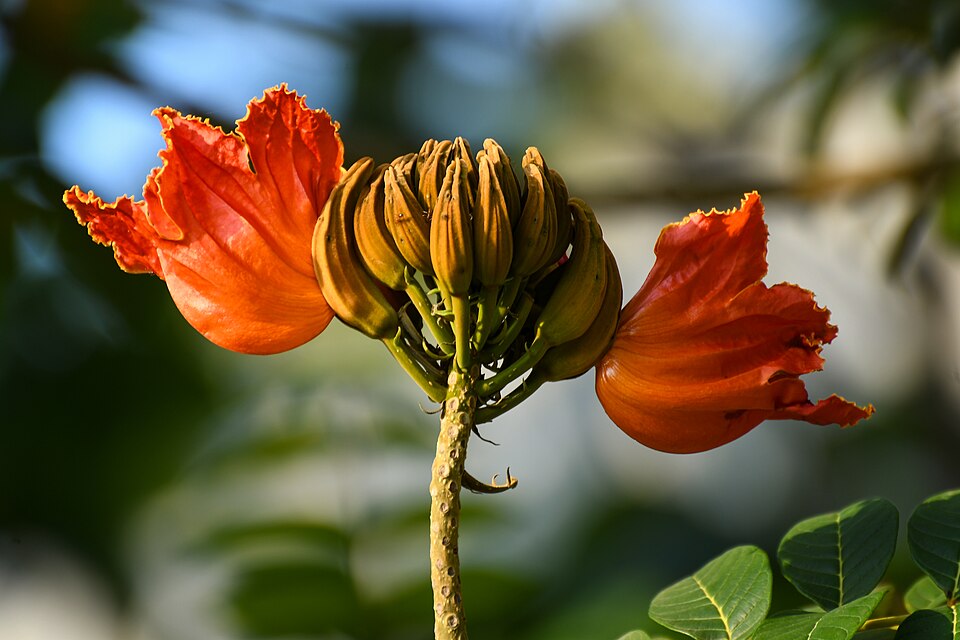
Photos
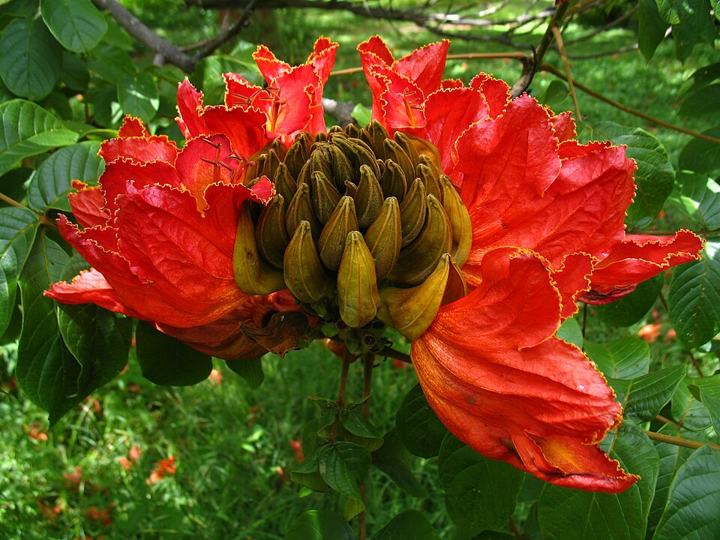
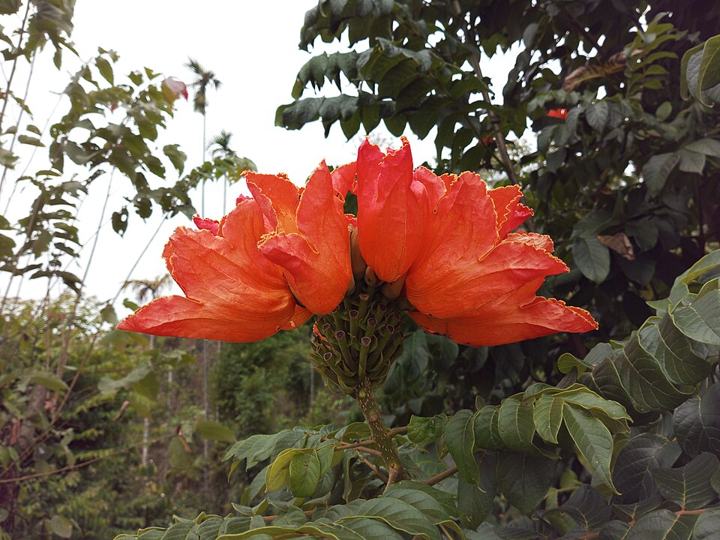
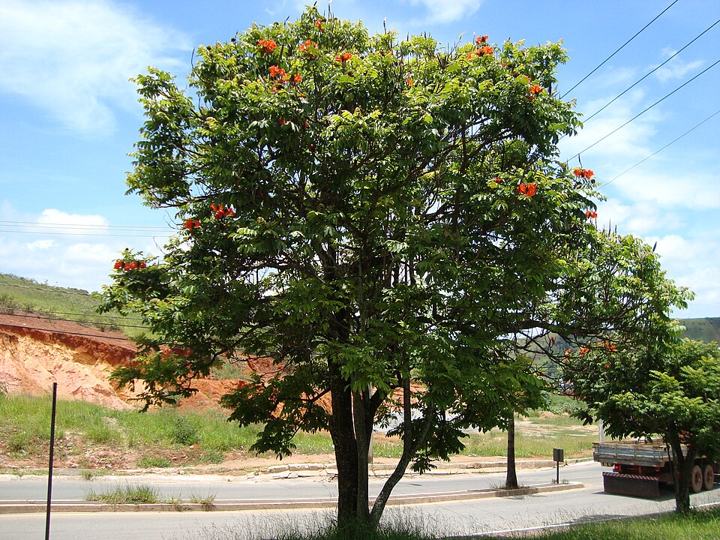
From Wikipedia
Spathodea is a genus in the plant family Bignoniaceae. The single species it contains, Spathodea campanulata, is commonly known as the African tulip tree or the Nandi Flame. The tree grows between 7–25 m (23–82 ft) tall and is native to tropical dry forests of Africa. It has been nominated as among 100 of the "World's Worst" invaders.
This tree is planted extensively as an ornamental tree throughout the tropics and is much appreciated for its very showy reddish-orange or crimson (rarely yellow), campanulate flowers.
Text from Wikipedia, CC BY-SA 4.0: Spathodea
Description
An evergreen or semi-deciduous tree from tropical Africa, which can reach 20 m in height, although in cultivation it averages 8–12 m. Tall trunk with greyish-brown, fissured bark and a more or less rounded crown. Leaves compound, long, with 9–17 ovate-lanceolate leaflets on very short stalks, up to 10 cm long, dark green. Flowers in terminal racemes, large (8–9 cm long) and very showy, bell- to cup-shaped, red-orange with a golden-yellow edge. Flowers almost all year round.
Propagation and growing
Although native to tropical Africa, it is widely grown throughout the tropics and subtropics of the world. In the Canaries it is commonly grown; it prefers sheltered conditions and a good water supply, although it tolerates periods of drought well. It is propagated by seed, cuttings and suckers.
Garden use
It is common on promenades, avenues and boulevards in towns. Low-maintenance, it tolerates vehicle pollution very well. A beautiful tropical tree, widely used in parks and gardens and in rows along streets and avenues. It is rather fragile in the wind.
Notes
Its abundant and spectacular flowering hides a drawback: when the flowers fall to the ground they become slippery when stepped on. They also make quite a mess.
Source: Cabildo de Tenerife, “Guía de especies vegetales”, CC BY. Translated from Spanish by us.
Bioclimatic belts
Warm coastal belt
- Inframediterranean, hyperarid
- Inframediterranean, arid
- Inframediterranean, semi-arid (lower level)
- Inframediterranean, semi-arid (upper level)
- Inframediterranean, dry, without trade-wind fog
- Inframediterranean, dry, with trade-wind fog
Warm mid-slope belt
- Thermomediterranean, semi-arid (lower level)
- Thermomediterranean, semi-arid (upper level), without trade-wind fog