
Canary tamarisk
Tamarix canariensis Willd. · Family: Tamaricaceae
A salt-loving coastal species of beaches, ravine mouths and cliffs. Stands up well to sea spray.
Where it grows on Tenerife
Grows in: South coast · North coast
Zones are derived approximately from the Cabildo belts.
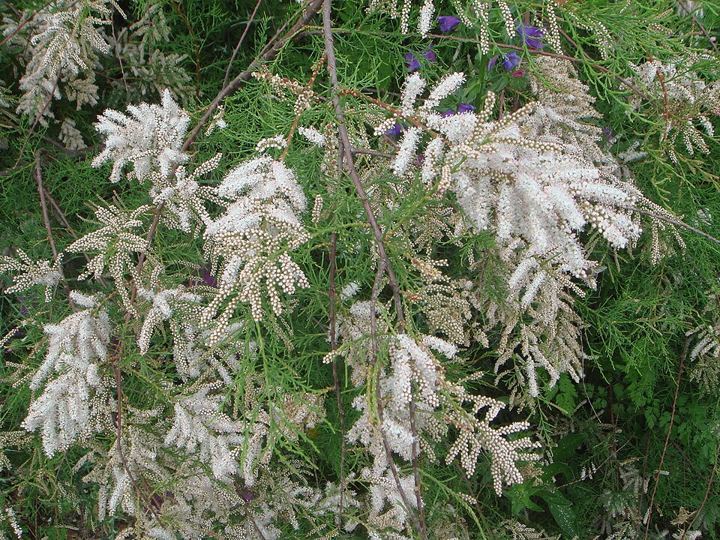
Photos
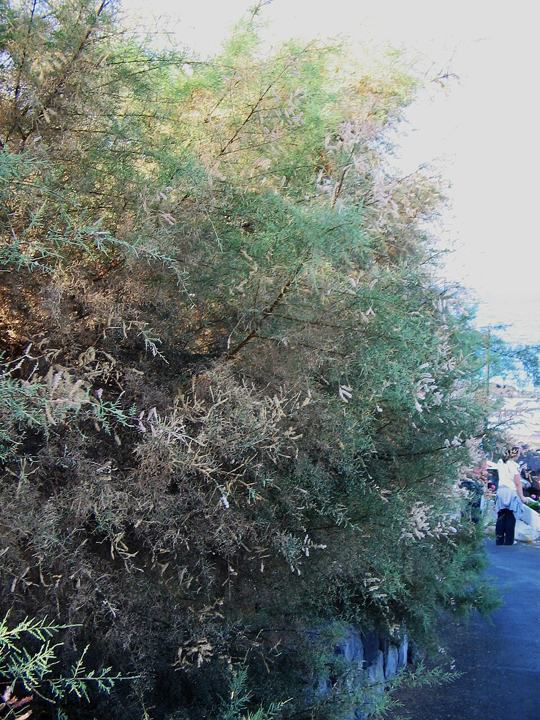
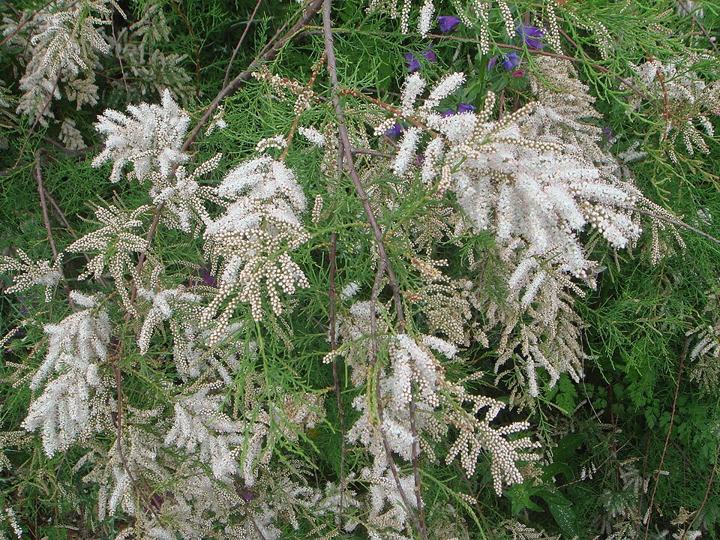
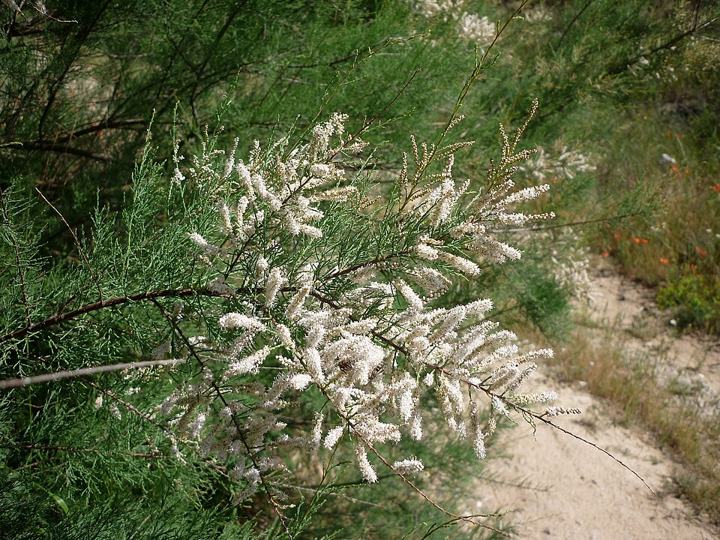
From Wikipedia
Tamarix canariensis is a species of flowering plant in the family Tamaricaceae. It is a shrub or small tree up to 4 m tall. It was previously said to be native to parts of Macaronesia, northern Africa and south-western Europe, but is now considered only to be found in the Canary Islands, the African and European species being Tamarix gallica. It was first described by Carl Ludwig Willdenow in 1816.
Text from Wikipedia, CC BY-SA 4.0: Tamarix canariensis
Description
Large shrub between 2 and 6 m tall, with reddish-brown bark. Leaves very small, 1–3 mm, scale-like, overlapping, with numerous salt-secreting glands. Tiny pink flowers in dense racemes. Flowers in spring and summer, sometimes continuing into autumn.
Propagation and growing
Its tiny fruits contain several hairy seeds that are quickly dispersed by the wind. Collecting seed for sexual propagation is therefore difficult, and it is usually propagated vegetatively from stakes, which produce small rootlets after two or three weeks in water. It multiplies well from cuttings. The plants need to stay at least a year in container cultivation to make sure their shoots are not "false". If ordered far enough in advance, they can be available in any native-plant nursery. A species of arid climates, it needs full sun and tolerates waterlogged and saline soils. It grows well right on the seafront and needs sandy or gravelly soils. It is usually fast-growing. It is generally propagated from hardwood or semi-hardwood cuttings, more rarely from seed. Available at the La Laguna nursery.
Garden use
It is widely used for windbreak hedges, forming a barrier that is also effective for reducing noise. It is often used in landscaping near the shoreline under the direct influence of salt spray, as it tolerates this environment perfectly. These are facultative halophytes: they tolerate soils saturated with brackish water but also thrive on moist ground with ordinary water. In any case they need some moisture and watering. They are grown for their attractive flowers and as windbreaks, in groups, as single specimens or in rows along seafront promenades. When large, its intricate branching gives good shade, although it constantly sheds bits of leaves and twigs onto the ground. They should be pruned periodically and take well to clipping, so they can be given attractive shapes.
Notes
The mistaken belief that the tarajal is highly harmful because it salinises the ground comes from the fact that it expels through its leaves the excess salt it absorbs from the soil. Also found in Cape Verde. The abundant natural coastal tamarisk stands of the i…
Protection status
Annex II of the Order of 20 February 1991 on the protection of wild flora of the Canary Islands.
Potential vegetation
Atriplici ifniensis-Tamaricetum canariensis.
Source: Cabildo de Tenerife, “Guía de especies vegetales”, CC BY. Translated from Spanish by us.
Bioclimatic belts
Warm coastal belt
- Inframediterranean, hyperarid
- Inframediterranean, arid
- Inframediterranean, semi-arid (lower level)
- Inframediterranean, semi-arid (upper level)
- Inframediterranean, dry, without trade-wind fog
- Inframediterranean, dry, with trade-wind fog
Districts
Anaga · Metropolitan area (Santa Cruz and La Laguna) · Acentejo · La Orotava Valley · Daute · Teno · South-west · Abona · South-east · Güímar Valley