
Cape honeysuckle
Tecomaria capensis (Thunb.) Spach · Family: Bignoniaceae
A species of warm places.
Where it grows on Tenerife
Grows in: South coast · North coast · South, 300–1000 m · North, 300–1000 m
Zones are derived approximately from the Cabildo belts.
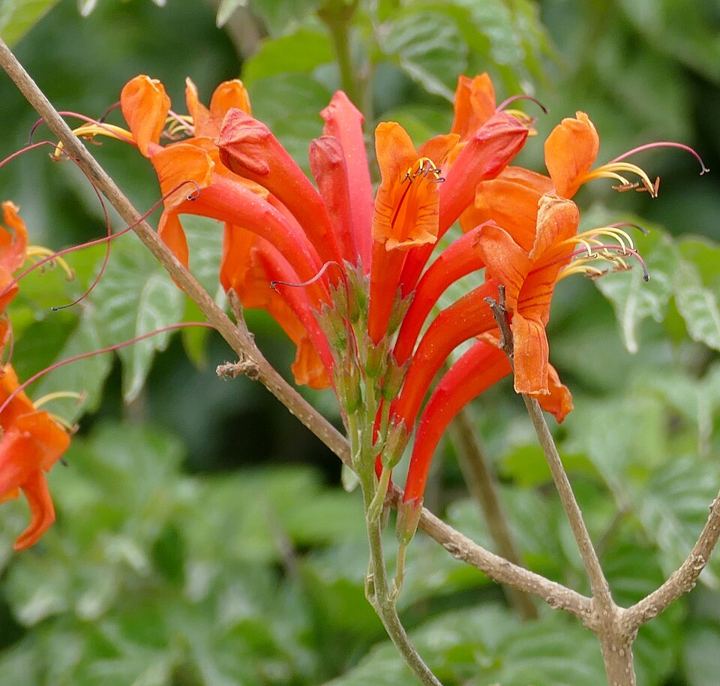
Photos
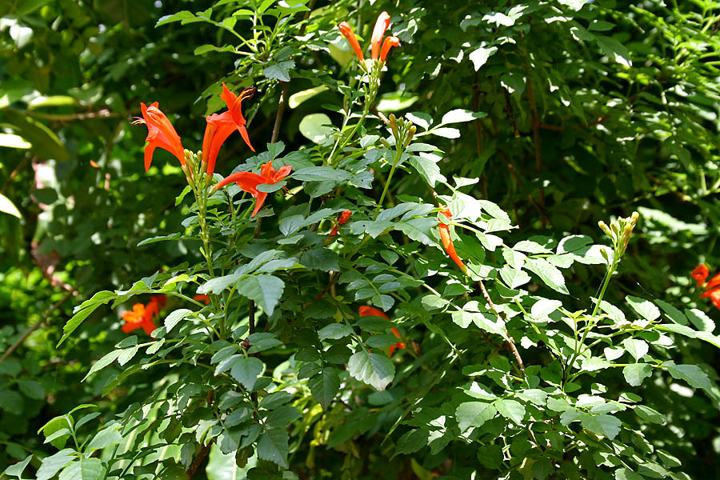
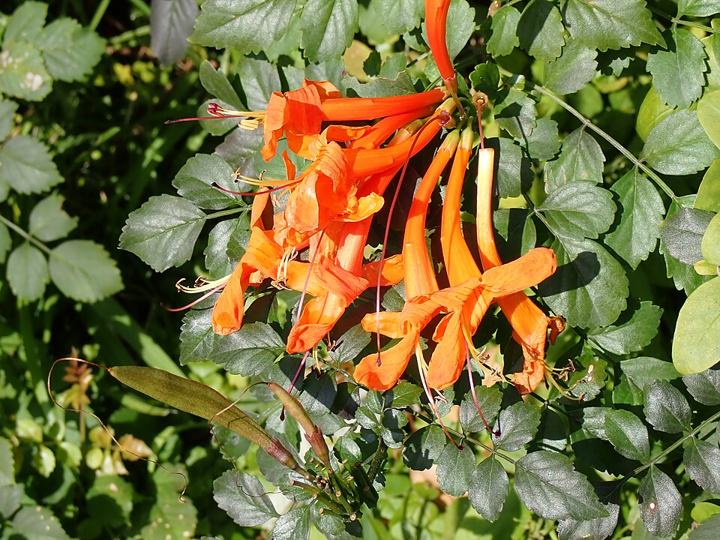
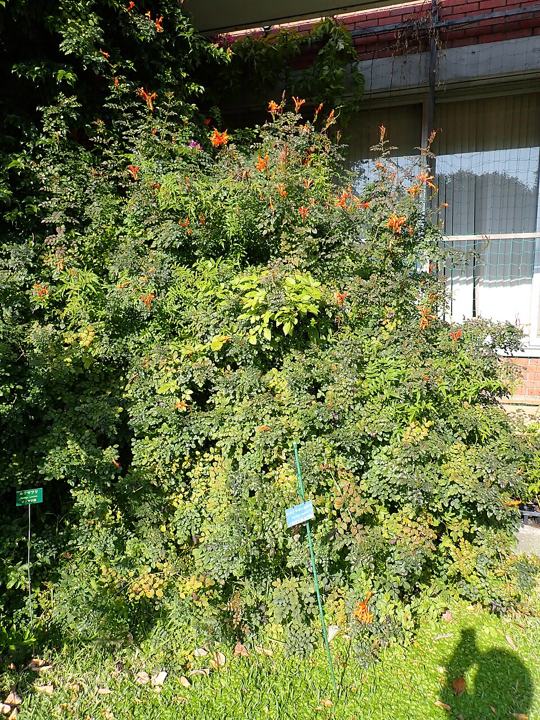
From Wikipedia
Tecomaria capensis, the Cape honeysuckle, is a species of flowering plant in the family Bignoniaceae, native to southern Africa. Despite its common name, it is not closely related to the true honeysuckle.
Text from Wikipedia, CC BY-SA 4.0: Tecomaria capensis
Description
Evergreen shrub native to South Africa, somewhat climbing, up to 4 m tall, which can sometimes become a small tree of up to 7 m. Leaves opposite or in whorls of three, imparipinnate, up to 15 cm long, with 7-9 ovate-elliptic leaflets with serrated margins, hairless and glossy on the upper surface. Inflorescences in terminal racemes, with tubular flowers that are red-orange, yellow, scarlet or pink depending on the variety. Flowers practically all year round.
Propagation and growing
A climbing evergreen shrub that is easy to grow, as it reproduces from cuttings and seed. It needs a sunny position and moderate watering. It can reach up to 4 m tall. It flowers in July and fruits in December. Drought-resistant and tolerant of sea proximity. Fairly sensitive to cold. Prefers sunny spots. Undemanding as to soil, it does best in rich, adequately moist, well-drained soils. It is propagated by seed, cuttings or air layering.
Garden use
A very useful garden plant, as it adapts very well to most environmental conditions. It can be watered regularly and tolerates hard pruning, above all to increase its flowering, which continues throughout the year. It is very well suited as a climber, so it is often chosen for walls, steep banks, fences, etc. It is used mainly in gardening to cover walls and railings and to form hedges, since it takes pruning well. It needs supports and regular watering in the hottest periods.
Notes
It is not much affected by whitefly.
Source: Cabildo de Tenerife, “Guía de especies vegetales”, CC BY. Translated from Spanish by us.
Bioclimatic belts
Warm coastal belt
- Inframediterranean, hyperarid
- Inframediterranean, arid
- Inframediterranean, semi-arid (lower level)
- Inframediterranean, semi-arid (upper level)
- Inframediterranean, dry, without trade-wind fog
- Inframediterranean, dry, with trade-wind fog
Warm mid-slope belt
- Thermomediterranean, semi-arid (lower level)
- Thermomediterranean, semi-arid (upper level), without trade-wind fog
- Thermomediterranean, semi-arid (upper level), with trade-wind fog
- Thermomediterranean, dry, with trade-wind fog
- Thermomediterranean, dry (lower level), without trade-wind fog
- Thermomediterranean, subhumid, with trade-wind fog