
Yellow broom (Teline osyrioides)
Teline osyrioides (Svent.) P.E. Gibbs & Dingwall · Family: Fabaceae
A cliff species of crags, steep slopes and ravine ledges, mostly north-facing, 400–1,300 m, in the thermophilous woodland belt.
Where it grows on Tenerife
Grows in: South coast · North coast · South, 300–1000 m · North, 300–1000 m
Zones are derived approximately from the Cabildo belts.
Description
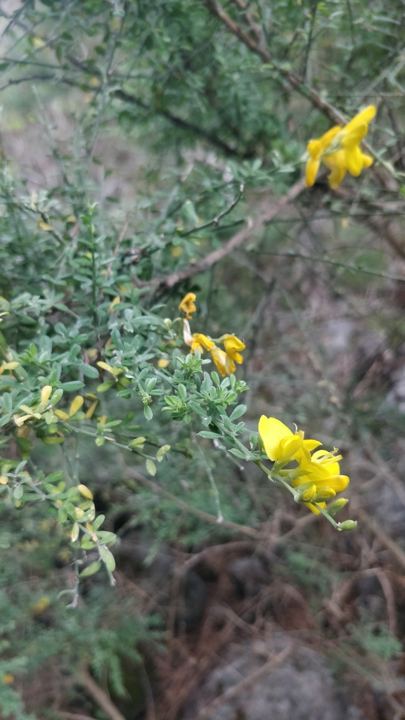
Small shrub up to 1.5 m tall. Leaves with linear to narrowly elliptic, sessile leaflets. Yellow flowers in terminal inflorescences of 4–15 flowers. Flowers in winter and spring.
Propagation and growing
The fruits of this species are small pods with at most 5 seeds each, ripening in early summer. The seeds have a low germination rate, which can be raised by immersing them in boiling water for one minute; if they are scarified by rubbing with fine sandpaper, the rate can reach 74% in 4 to 8 days (M. del Arco, 1994), but the procedure is very laborious. The species does not do well in cultivation and is prone to pest attack; it is undemanding as to soil and moisture and needs moderate sun. It is not usually available in nurseries.
Garden use
A small broom-like shrub that can reach 1.5 m in height, with yellow flowers in winter and spring, which gives it some interest as an ornamental. It has a wide altitudinal range (400–1,300 m above sea level) and also special conservation interest, as it is listed as rare (R) in the Red Book of threatened species of the Canary Islands, which proposes encouraging its cultivation as an ornamental plant as a conservation measure.
Notes
There are two subspecies. Subspecies "osyrioides" grows in two separate locations: Masca in the north-west of the island and the Ladera de Güímar. Subspecies "sericea" grows scattered along the "bandas del sur" (the southern slopes) (M. del Arco, 1996).
Protection status
Annex II of the Order of 20 February 1991 on the protection of wild flora of the Canary Islands.
Potential vegetation
Junipero-Oleetum cerasiformis; Visneo-Arbutetum canariensis.
Source: Cabildo de Tenerife, “Guía de especies vegetales”, CC BY. Translated from Spanish by us.
Bioclimatic belts
Warm coastal belt
- Inframediterranean, semi-arid (upper level)
- Inframediterranean, dry, without trade-wind fog
- Inframediterranean, dry, with trade-wind fog
Warm mid-slope belt
- Thermomediterranean, semi-arid (lower level)
- Thermomediterranean, semi-arid (upper level), without trade-wind fog
- Thermomediterranean, semi-arid (upper level), with trade-wind fog
- Thermomediterranean, dry, with trade-wind fog
- Thermomediterranean, dry (lower level), without trade-wind fog
Districts
Teno · Abona · South-east · Güímar Valley