
Mocán (Visnea mocanera)
Visnea mocanera L. f. · Family: Theaceae
Typical of the warmer laurel forest, readily spreading beyond it.
Where it grows on Tenerife
Grows in: North coast · North, 300–1000 m
Zones are derived approximately from the Cabildo belts.
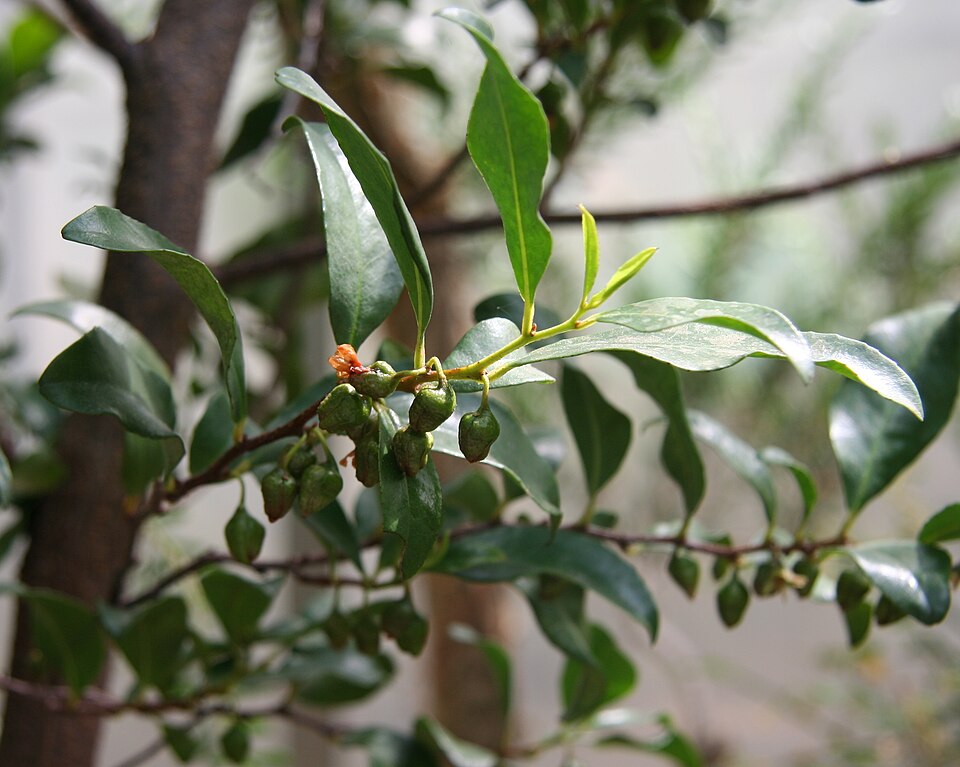
Photos
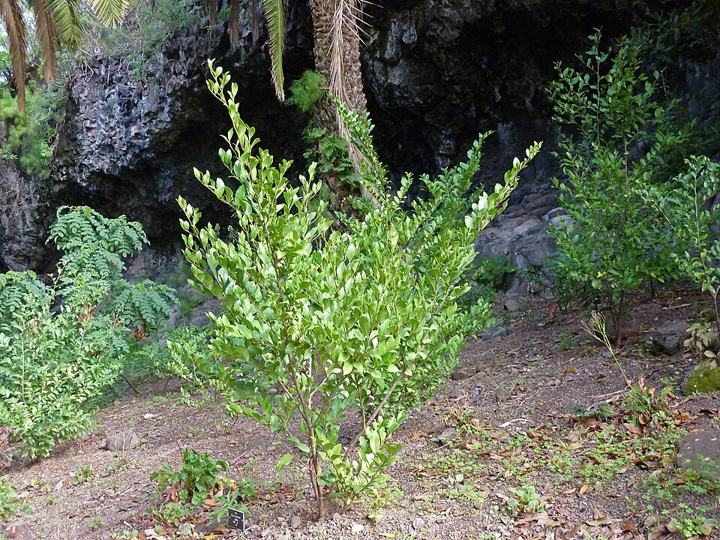
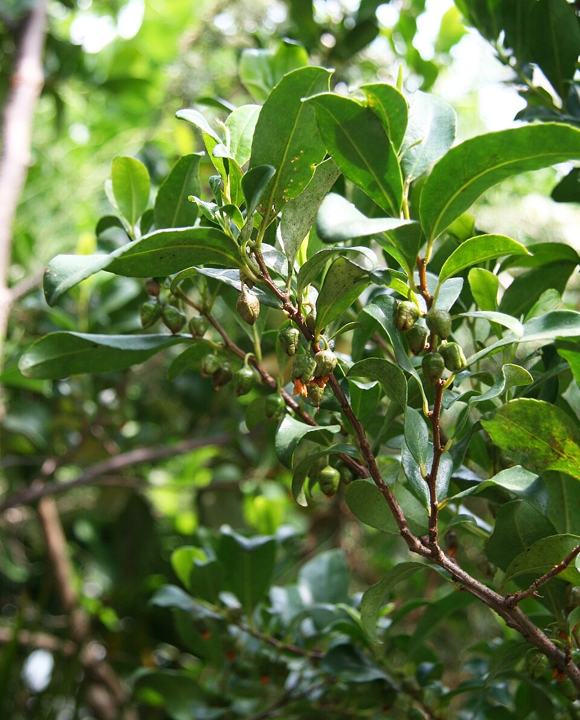
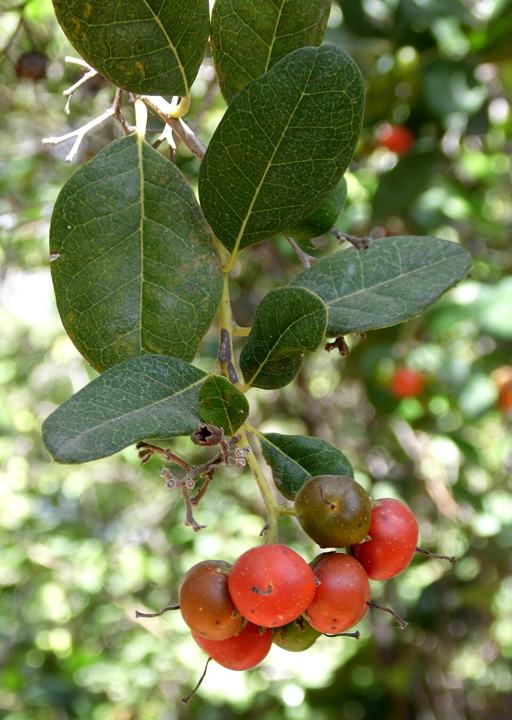
From Wikipedia
Visnea is a monotypic genus of flowering plants in family Pentaphylacaceae. The genus contains a single species, Visnea mocanera a tree native to the Canary Islands and Madeira.
The fruits of the tree (known as Mocan) are edible.
The genus name of Visnea is in honour of Gérard de Visme (c. 1725 – c. 1797), a French and English merchant in Lisbon, Portugal. The genus was first described by Carl Linnaeus the Younger in 1782, and published in Suppl. Pl. on page 36.
Note; Visnea Steud. ex Endl. is a synonym of Barbacenia, a genus in a different family.
Text from Wikipedia, CC BY-SA 4.0: Visnea
Description
An evergreen tree, generally 6–8 m tall, although it can reach 15 m, with greyish bark and angular twigs. The leaves are elliptic-lanceolate, not very large (4–6 cm long), glossy dark green, with a slightly serrated margin and a reddish midrib. Flowers small, fragrant, bell-shaped, pendulous, creamy white. Fruits subglobose, reddish. Flowers and fruits almost all year round.
Propagation and growing
The edible fruits of the mocán (“yoyas”) enclose a very hard nutlet that can hold two embryos, so that two seedlings may sprout from each nutlet, of which, in general, only one survives. The seeds must be cleaned of the remains of the fruit by hand if they are to germinate easily. Viable seedlings are vigorous and easy to grow, and we have only detected a certain tendency to be attacked by aphids, which can be eliminated by spraying with macerated nicotine (tobacco infusion). It requires neutral soils and a sunny or semi-shaded position. It is scarce in nurseries, probably owing to a lack of knowledge of the particularities of its germination. Container-grown plants develop normally and can reach half a metre in height after one year.
Garden use
This tree, which can reach 15 m in height, flowers in winter and spring. Its value as an ornamental plant in landscaping is great, owing to its beauty and the wide climatic range it tolerates. Its conservation value is also high because of its scarcity, as is its scientific value, being the only representative of the family Theaceae in the Macaronesian Region and north-west Africa; other related species are found as far away as South-East Asia. The maintenance it needs once planted is minimal, requiring only moderate watering in the dry season of the first year. All this leads us to consider this species particularly interesting for use and cultivation.
Notes
This tree was one of the most prized and used by the prehistoric inhabitants of the islands, who made honeys and liqueurs (“Chacerquén”) from its fruits (“yoyas”), with medicinal and stimulant properties. Certain individuals (“Mocanas”) have a…
Protection status
Annex II of the Order of 20 February 1991 on the protection of wild flora of the Canary Islands.
Potential vegetation
Visneo mocanerae-Arbutetum canariensis.
Source: Cabildo de Tenerife, “Guía de especies vegetales”, CC BY. Translated from Spanish by us.
Bioclimatic belts
Warm coastal belt
- Inframediterranean, dry, with trade-wind fog
Warm mid-slope belt
- Thermomediterranean, semi-arid (upper level), with trade-wind fog
- Thermomediterranean, dry, with trade-wind fog
Districts
Anaga · Metropolitan area (Santa Cruz and La Laguna) · Daute · South-east · Güímar Valley