
Norfolk Island pine
Araucaria heterophylla (Salisb.) Franco · Family: Araucariaceae
Needs a mild climate and dislikes frost. Grown on the coast, but does best at warm, humid mid elevations.
Where it grows on Tenerife
Grows in: South coast · North coast · South, 300–1000 m · North, 300–1000 m · Above 1000 m
Zones are derived approximately from the Cabildo belts.
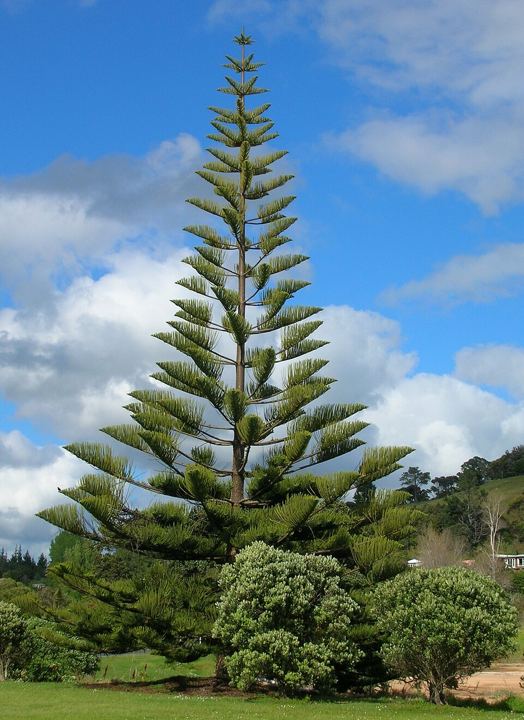
Photos
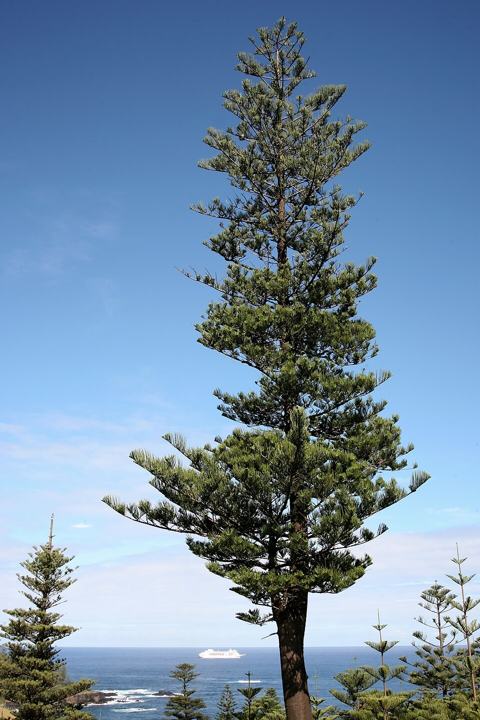
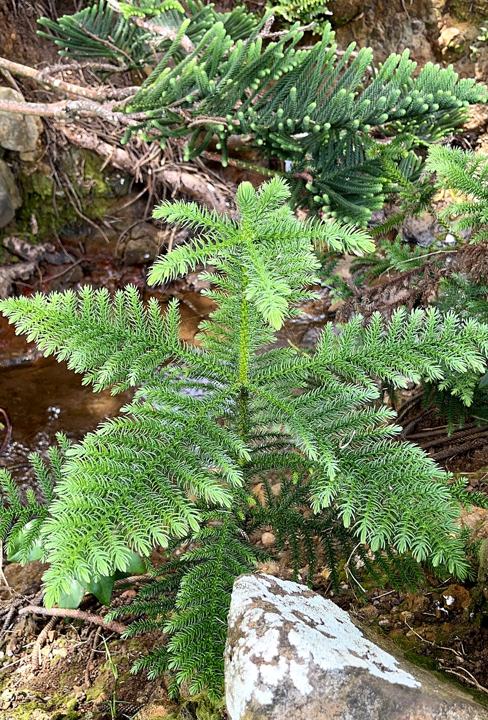
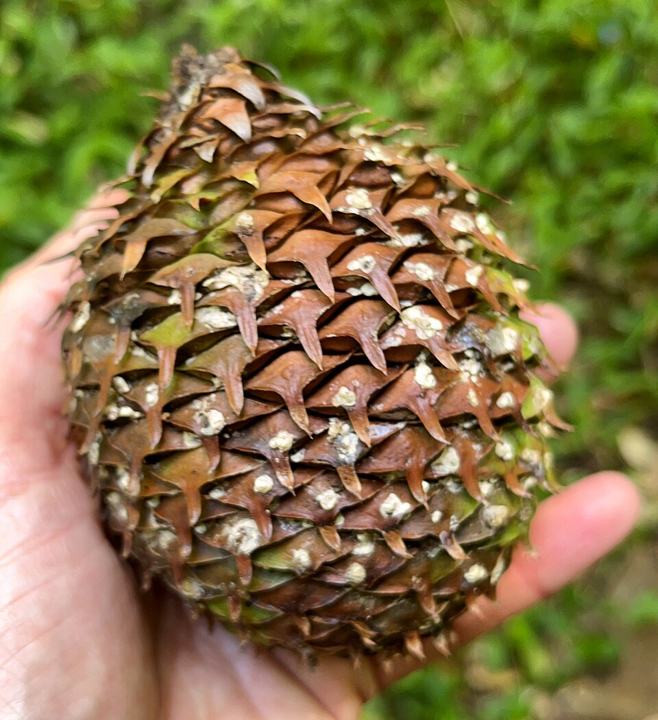
From Wikipedia
Araucaria heterophylla (synonym A. excelsa) is a species of conifer. As its vernacular name Norfolk Island pine (or Norfolk pine) implies, the tree is endemic to Norfolk Island, an external territory of Australia located in the Pacific Ocean between New Zealand and New Caledonia. It is not a true pine, which belong to the genus Pinus in the family Pinaceae, but instead is a member of the genus Araucaria in the family Araucariaceae, which also contains the hoop pine and the monkey-puzzle tree. It is sometimes also called a star pine, Polynesian pine, triangle tree or living Christmas tree, due to its symmetrical shape as a sapling.
Text from Wikipedia, CC BY-SA 4.0: Araucaria heterophylla
Description
An evergreen tree of pyramidal habit, which can reach 50 m in height, with a straight trunk up to 1.75 m in diameter, horizontal main branches arranged in regular whorls, and bark that peels off in thin plates. Twigs densely covered with leaves; the young ones awl-shaped, soft, spreading, bright green; the adult ones overlapping and curved towards the tip, forming a long, flexible cylinder. Male cones elongated, yellowish-brown, with numerous overlapping scales. Female cones globose, erect, 10–15 cm long, with scales ending in a long triangular point curved backwards. A species native to Norfolk Island, east of Australia. It flowers in spring, although flowering does not follow a very strict periodicity; the cones ripen in autumn and take two or three years to mature. They are unisexual, dioecious trees, that is, with male and female individuals.
Propagation and growing
It is propagated by seed or grafting, but apical cuttings are also used when it is grown as a houseplant. It reproduces by seed or shoots; it grows in relatively fertile soils, although it can tolerate a certain degree of alkalinity. It needs moderate watering and sunny positions.
Garden use
It is grown in gardens, preferably as a specimen tree, although it can also be used in rows along promenades and avenues. Young specimens are sold as houseplants. It is grown outdoors, although it can also be grown as a houseplant; it is a hardy species, although it does not withstand frost. Its use on slopes is recommended to check erosion and landslides. It accepts pruning and requires little maintenance. It can be seen in parks, gardens, squares and green areas in general.
Notes
It is highly valued as an ornamental for its pyramidal habit, with branches arranged in regular tiers, which makes it very elegant; hence it also received the specific name “excelsa”.
Source: Cabildo de Tenerife, “Guía de especies vegetales”, CC BY. Translated from Spanish by us.
Bioclimatic belts
Warm coastal belt
- Inframediterranean, semi-arid (lower level)
- Inframediterranean, semi-arid (upper level)
- Inframediterranean, dry, without trade-wind fog
- Inframediterranean, dry, with trade-wind fog
Warm mid-slope belt
- Thermomediterranean, semi-arid (lower level)
- Thermomediterranean, semi-arid (upper level), without trade-wind fog
- Thermomediterranean, semi-arid (upper level), with trade-wind fog
- Thermomediterranean, dry, with trade-wind fog
- Thermomediterranean, dry (lower level), without trade-wind fog
- Thermomediterranean, subhumid, with trade-wind fog
- Thermomediterranean, dry (upper level), without trade-wind fog
- Thermomediterranean, humid, with trade-wind fog
Temperate belt of laurel and pine forest
- Mesomediterranean, lower, semi-arid (upper level), without trade-wind fog
- Mesomediterranean, lower, dry, with trade-wind fog
- Mesomediterranean, lower, dry, without trade-wind fog
- Mesomediterranean, lower, subhumid, with trade-wind fog
- Mesomediterranean, lower, subhumid, without trade-wind fog
- Mesomediterranean, lower, humid, with trade-wind fog
- Mesomediterranean, upper, dry, without trade-wind fog
- Mesomediterranean, upper, subhumid, without trade-wind fog
- Mesomediterranean, upper, humid, without trade-wind fog