
Carob tree
Ceratonia siliqua L. · Family: Fabaceae
A typical Mediterranean tree, naturalised on almost every island. Likes warmth and sun, tolerates drought well, is sensitive to cold. Found near the coast and in ravine bottoms.
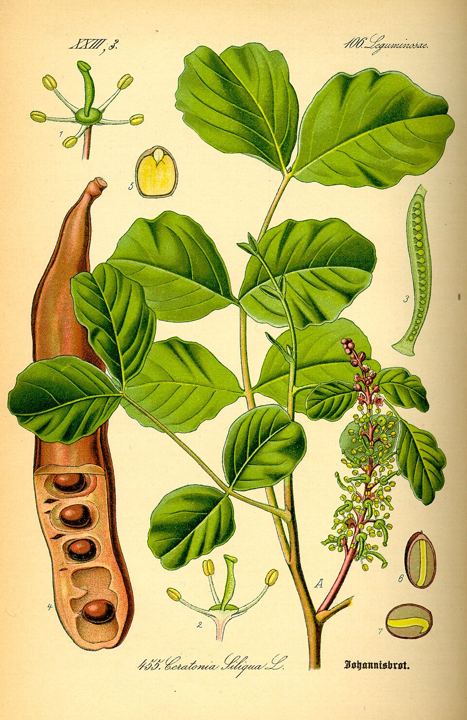
Photos
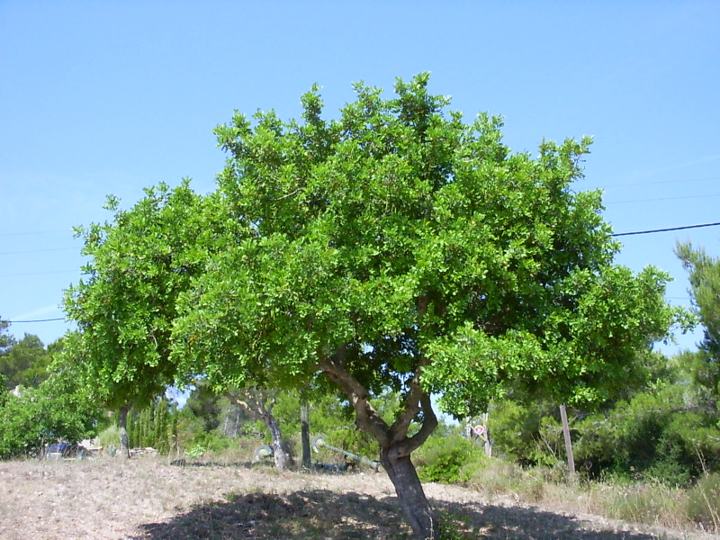
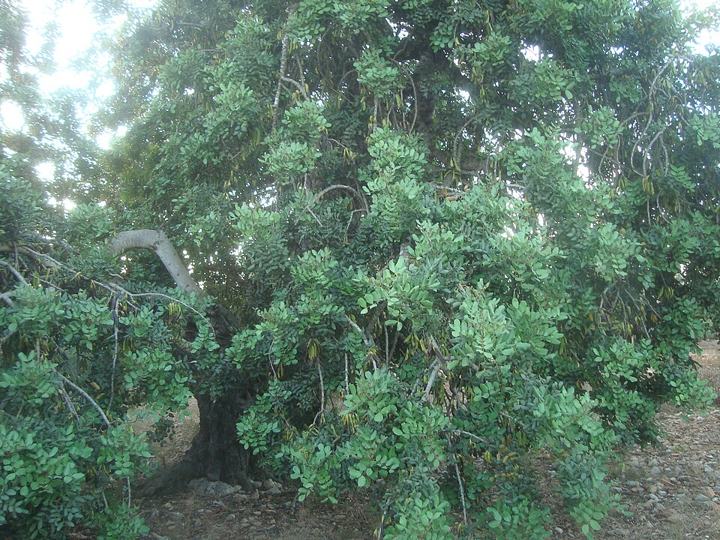
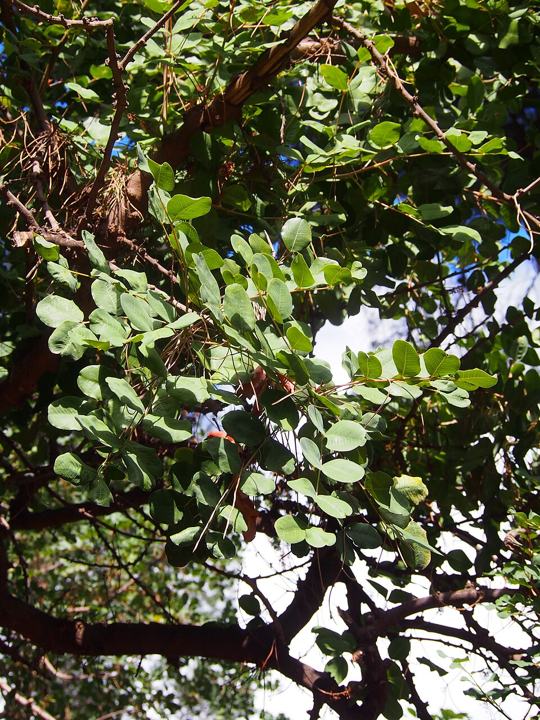
From Wikipedia
The carob ( KARR-əb; Ceratonia siliqua) is a flowering evergreen tree or shrub in the Caesalpinioideae subfamily of the legume family, Fabaceae. The carob tree is native to the Mediterranean region and the Middle East. It is widely cultivated for its edible fruit, which takes the form of seed pods, and as an ornamental tree in gardens and landscapes. Spain is its largest producer, followed by Italy and Morocco.
Carob pods have a number of culinary applications, including a powder or chips that can be used as a chocolate alternative. The seeds are used to produce locust bean gum or carob gum, a common thickening agent used in food processing.
Text from Wikipedia, CC BY-SA 4.0: Carob
Description
The carob is a characteristic Mediterranean tree, evergreen and much-branched, reaching up to 12 m in height. It has a short but robust trunk, often twisted and irregular, with thick, greyish, smooth bark, and an extensive, deep root system. The leaves are dark green, leathery and compound, made up of rounded or oval leaflets with entire margins, borne opposite in pairs, up to 5 pairs (paripinnate). The flowers are inconspicuous, being tiny and hairless, but they give off a strong smell. They arise directly from the trunk or from side branches in clustered groups. There are female, male and hermaphrodite flowers, generally on different plants. The fruits are the well-known carob pods: slightly curved legumes resembling a flattened horn. They measure up to 25 cm and are greenish at first, turning blackish-brown when ripe. They contain 10 to 16 dark brown, very hard seeds.
Propagation and growing
It is a warm-climate tree that needs sunny places and withstands drought quite well. It flowers from September to January and fruits in summer. It is indifferent to the type of substrate and grows even on stony or arid soils, although it prefers limestone ground. For this reason it adapts well to the Canarian climate and terrain, where it has often been cultivated. Very wet soils harm it. This species is propagated by seed. The seeds should be soaked in concentrated sulphuric acid for 1 hour, or soaked in boiling water and left in cold water overnight. Nursery sowing is recommended in spring or autumn. For use as a fruit tree, large-capacity containers are used. For forestry use, plants of two or three growth seasons can be used, in 300–400 cm³ containers, giving plants with a final size of 10–20 cm. Regarding light intensity, greenhouse studies show that full exposure improves seed germination, favours root and leaf development, increases the plant’s photosynthetic activity and leads to more efficient water use; results that are useful for improving the management of young plants to be transplanted under arid conditions.
Garden use
Pulp is extracted from its highly nutritious fruits for animal or human food. In the past it was eaten fresh as a natural sweet, and it was a major food reserve when other crops and fodder failed. In former times Canarian fishermen also used the fruits to keep their fishing gear from deteriorating. In some countries the seeds are used as a base for alcoholic drinks, and they also have other applications in the pharmaceutical industry (laxatives, capsules and toothpaste), cosmetics (shaving creams), textiles (finishes and printing) and chemicals (paints, polishes and glues). The carob has also sometimes been grown as a shade tree because of its habit and drought resistance. Since it flowers in high summer, bees use carob flowers to make honey, although this honey is not fit for human consumption, as it is not at all pleasant to the taste.
Notes
Its pollen is allergenic, so male or hermaphrodite specimens can be problematic for sensitive people, whereas female specimens have the double advantage of producing no pollen while producing carob pods, which add interest and val…
Source: Cabildo de Tenerife, “Guía de especies vegetales”, CC BY. Translated from Spanish by us.