
Aulaga (Launaea arborescens)
Launaea arborescens (Batt.) Murb. · Family: Asteraceae
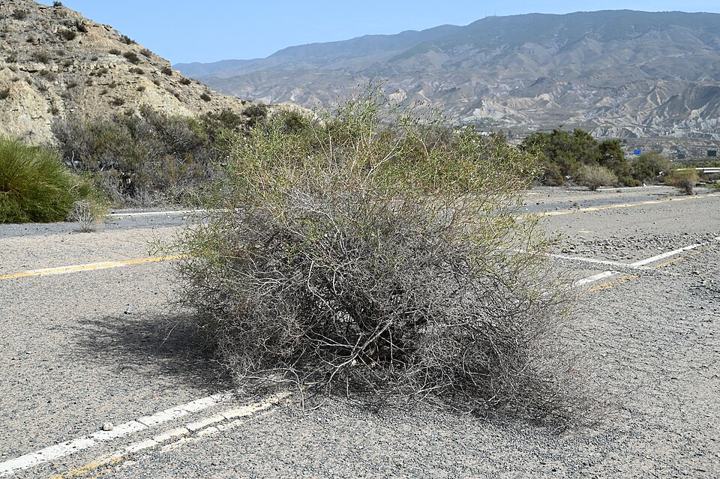
A native of the coast and arid, desert-like places, growing in disturbed scrub. Moderately salt tolerant.
Photos
Description
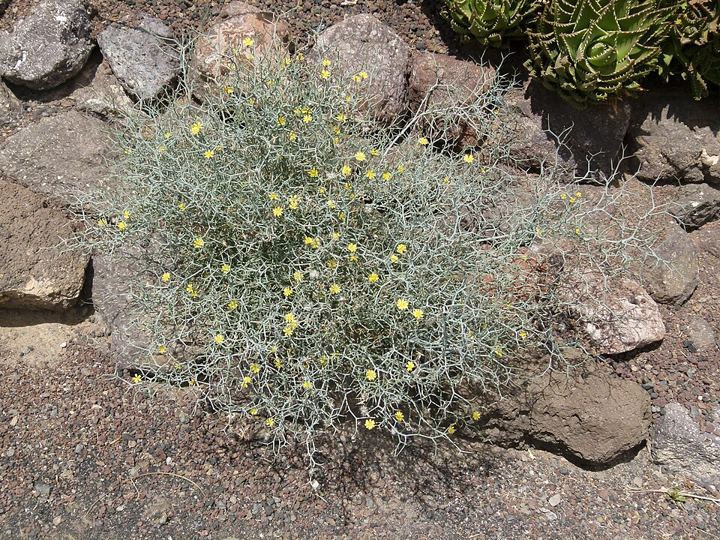
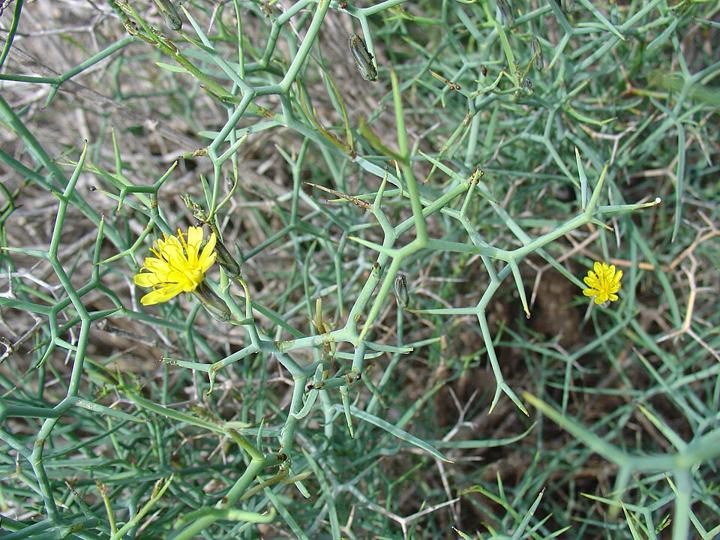
A shrub with a woody base, dense and tangled in appearance, much branched in a zigzag pattern (at angles of 80–100º), with milky latex and an unpleasant smell; it looks spiny once the flower heads have fallen, but these 'spines' are in fact pseudo-spines, formed from the modified flower-head stalks left behind after the heads have died, withered and dropped. It is 50–100 cm tall, sometimes up to 150 cm, and has robust roots that reach deep vertically but also spread laterally. The leaves, usually somewhat succulent, in a rosette or clustered at the base of the shoots, are more or less linear, 1 to 5 mm wide by 1–8 cm long, entire or slightly toothed or even pinnatifid, more or less clasping and decurrent, and soon falling. Each shoot bears a cylindrical to conical flower head 7–15 mm tall; the outer involucral bracts are imbricate with scarious margins, the inner ones gradually longer and lanceolate. They surround a receptacle with 7–19 ligules, the corolla limb 5–8 by 2–3 mm with a five-toothed tip, yellow, the underside often streaked with red. The cypselas, somewhat dimorphic, 2.5–5 by 0.7–1.3 mm, are prismatic, all with 5 main ribs plus 2 secondary ones and transverse tuberculate wrinkles; the inner ones are narrowly wedge-shaped and light brown, the outer ones slightly curved and compressed, thicker and dark brown. They are crowned by a pappus 5–8 mm long, somewhat dimorphic, of numerous bristles that become finer from the centre outwards.
Propagation and growing
Propagation by seed. Germination in standard substrate. The species shows good germination rates at any time of year.
Garden use
A species of great interest as an ornamental. It is occasionally used as fodder for goats and rabbits. Its boiled inflorescences and shoot tips are known to have anti-jaundice, blood-sugar-lowering, tonic, dyeing and vesicant properties. It has a low water requirement and a high need for hours of sunlight. It develops best at mild temperatures (22 ºC), although it withstands high temperatures. It adapts well to picón (volcanic gravel) and well-drained soils, even on malpaís (rough lava fields). Its root growth is small, so there is no need to fear any destructive effect underground. It flowers between April and September.
Notes
Various uses are known: on the one hand, its tender shoots serve as fodder for livestock, although eating large amounts can change the taste of sheep's and goats' milk, making it sour; on the other hand, it was used as fuel already…
Protection status
Not listed.
Potential vegetation
Matorrales de sustitución. Matorrales colonizadores de areas alterdas de las zonas bajas…
Source: Cabildo de Tenerife, “Guía de especies vegetales”, CC BY. Translated from Spanish by us.
Districts
Metropolitan area (Santa Cruz and La Laguna) · Acentejo · La Orotava Valley · Daute · South-west