
Common myrtle
Myrtus communis L. · Family: Myrtaceae
Native to southern Europe and North Africa.
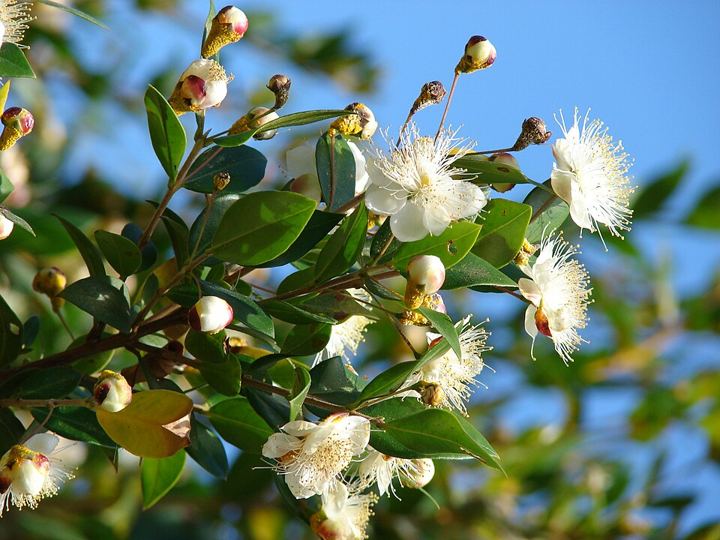
Photos
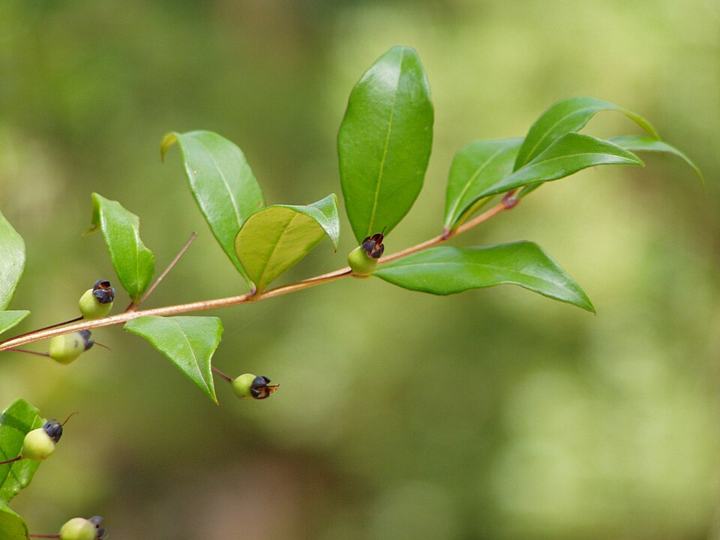
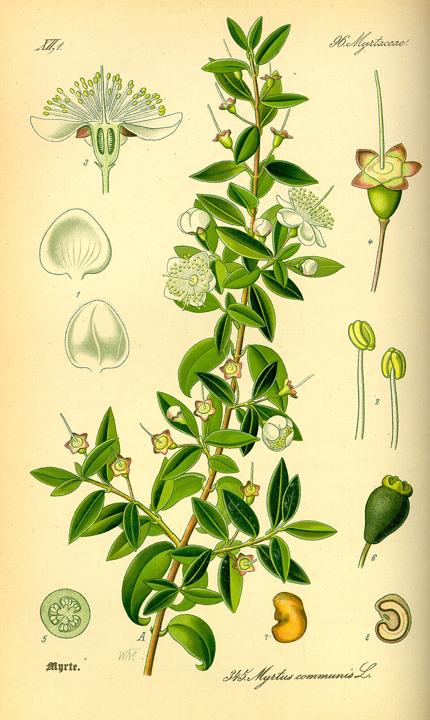
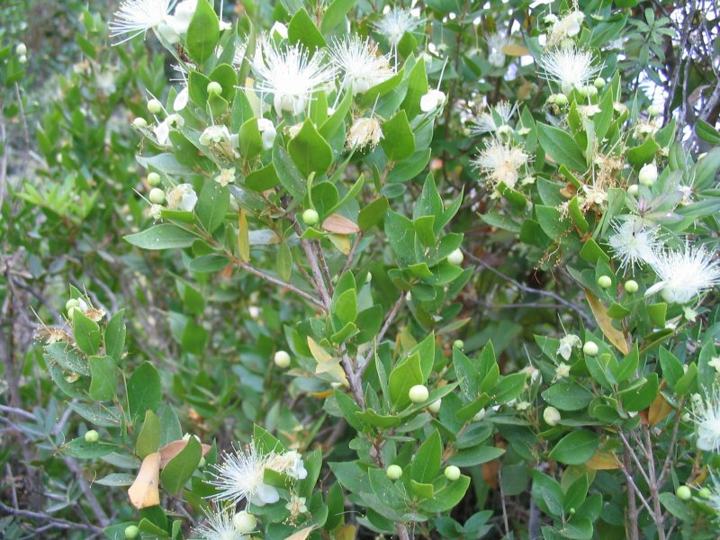
From Wikipedia
Myrtus communis, the common myrtle or true myrtle, is an Old World species of flowering plant in the myrtle family, Myrtaceae. It forms an evergreen shrub.
Text from Wikipedia, CC BY-SA 4.0: Myrtus communis
Description
Evergreen, aromatic shrub with a stem up to 5 m tall and compact foliage. The leaves are opposite, leathery, short-stalked, entire, oval or lanceolate, dark green on the upper surface and paler on the underside, with transparent oil glands in the leaf blade. Flowers white, solitary on long axillary stalks, with five petals and five sepals, very fragrant, 1 to 2 cm across. The stamens are yellow. Flowers in spring. The fruit is an edible, rounded berry 1 to 1.5 cm in diameter, dark blue with a waxy bloom when ripe, crowned by the calyx. It has many seeds, which are dispersed by the birds that feed on it.
Propagation and growing
Myrtle propagates very well from seed. Sowing should be done in late winter or early spring, at temperatures of 20-30 ºC and a depth of 4-5 mm. Once sown, germination can be seen from 10-15 days. The germination rate is 80-90% for seed of the current year; with these results no pre-germination treatment is needed. Myrtle is extremely tough as regards soil. This is not a factor we need to worry about. Feeding is optional and can be done every 15 days during spring and summer with a low-nitrogen fertiliser. It can be skipped if preferred. It is easily propagated by semi-ripe or hardwood cuttings in autumn. Indoors it is unlikely to suffer from diseases and pests, but to mention a few, the well-known whitefly and scale insects.
Garden use
It is often grown as an ornamental. The leaves, flowers and fruits are rich in an aromatic oil used in perfumery. The plant was very famous in antiquity, when it was considered a symbol of love and beauty. Olympic champions were honoured with myrtle wreaths. It is also used as a remedy for colds and as an antiseptic. For lung and bronchial complaints it is taken as a herbal tea, at a rate of 1 ounce of leaves per litre of water; it is sweetened to the patient's taste and 3 cups a day are given after meals, as hot as possible, and preferably with the infusion freshly made with the proportional amount of leaves and water. Myrtle needs direct sun, although it also tolerates filtered light. As for temperatures, it will obviously cope well with heat, and in fact prefers it. With all this sun exposure, high temperatures come hand in hand. Winter is the only season in which the plant needs cold for its rest period, when it is best kept somewhat cooler; it can tolerate temperatures down to 5 ºC. Given this, we can forget about growing it outdoors in cold areas. For indoor care, watering should be regular, without letting the soil dry out completely in spring, summer and autumn. During the winter rest, watering can be stopped, although it is advisable to help it a little with very occasional watering.
Source: Cabildo de Tenerife, “Guía de especies vegetales”, CC BY. Translated from Spanish by us.