
Rosemary
Rosmarinus officinalis L. · Family: Lamiaceae
A Mediterranean species naturalised in the Canaries. Grows in any soil, best dry, sandy and permeable, and copes well with poor ground. From the coast to 1,500 m in dry sunny places.
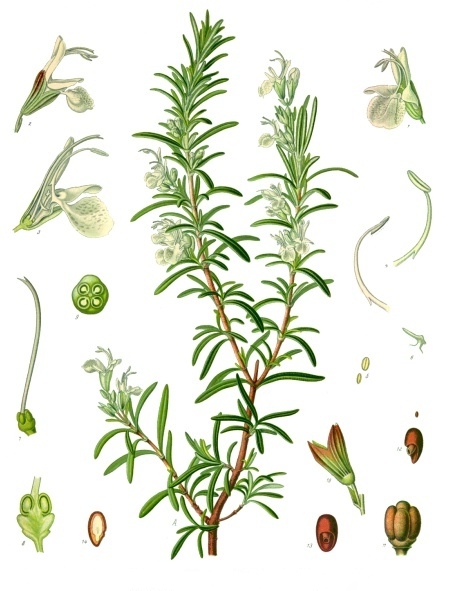
Photos
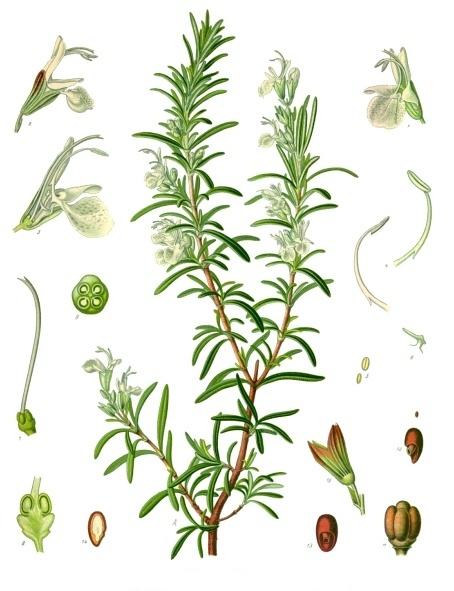
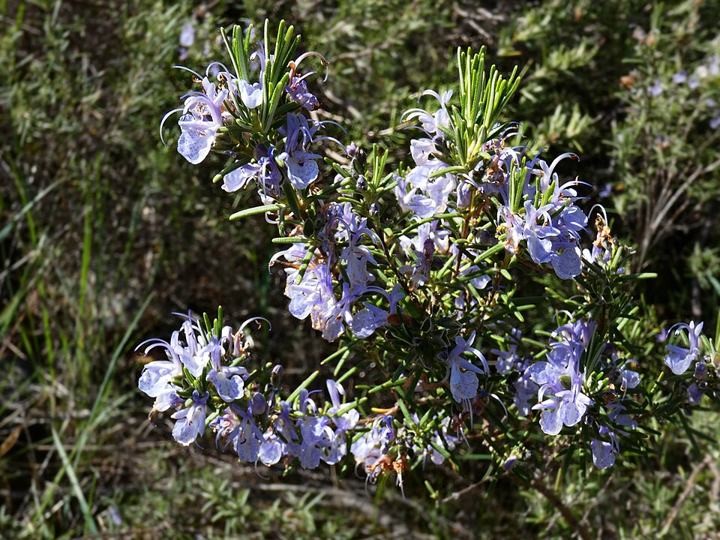
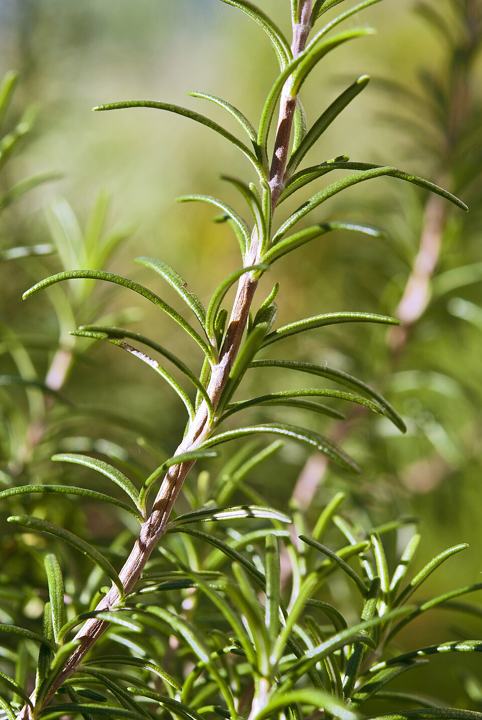
From Wikipedia
Salvia rosmarinus, synonym Rosmarinus officinalis, commonly known as rosemary, is a shrub with fragrant, evergreen, needle-like leaves and purple or sometimes white, pink, or blue flowers. It is a member of the mint family, Lamiaceae. The species is native to the Mediterranean region. It has numerous cultivars, and its leaves are commonly used as a flavoring.
Text from Wikipedia, CC BY-SA 4.0: Rosemary
Description
Rosemary is an aromatic, woody, evergreen shrub, much branched and sometimes squat, which can reach 2 metres tall. The young stems are covered in down, which disappears as they grow, while older stems are reddish with cracked bark. The leaves, small and very numerous, are linear. They are opposite, sessile, entire, with down-turned margins and dark green, while the underside is whitish and covered in hairs. The flower clusters arise where the leaf joins the stem. The flowers are about 5 mm long. The corolla is two-lipped and fused into a single piece. The colour is pale violet-blue, pink or white, with a green or slightly reddish calyx, also two-lipped and bell-shaped. The flowers are axillary, very aromatic and rich in nectar for bees; they are found at the tips of the branches and have two curved stamens fused to the corolla, with a small tooth. The fruit, enclosed at the base of the calyx, consists of four nutlets 1.5-3 by 1-2 mm, ovoid, flattened, light chestnut in colour with a pale spot at the point of attachment.
Propagation and growing
Plants should be spaced 50 centimetres apart. It is a very easy species to propagate. If you take cuttings from rosemary branches and stand them in a container of water, within a few days you will see roots starting to form. Propagation from seed is more difficult and takes much longer.
Garden use
An old saying goes: "You could write a whole book on the virtues of rosemary". It is used as a seasoning and also in medicine and perfumery. It is a vulnerary plant, that is, one that heals wounds and sores (as another saying puts it, "It's a bad sore that rosemary cannot heal"), for which an infusion of the flowering tops has been used. Likewise, the famous rosemary spirit has long been used to soothe aching parts and muscle fatigue. Its leaves yield "Hungary water" (the Queen of Hungary's water) for perfumery, as well as a distilled water used as an eyewash; the essential oil can be used to combat rheumatic pain. It is also used for relaxing baths, as a revitalising face mask and as a hair tonic. In the kitchen it is used for roasts, stews, sofritos, soups and sauces, and "rosemary wine" can also be made, beneficial for the stomach. It is planted in groups and also for borders and low hedges. It is a warmth-loving species, growing best in dry, sunny places on any type of soil, preferably limestone. Rosemary needs at least 6 hours of sunlight a day, so it should be planted in spots with good sun exposure. It grows best in sandy soil, though it adapts easily to other, poorer soils, except clay. As for water, moderate watering is enough. The plant should not be watered too often.
Notes
It is said to keep pests away, so the plants around it are protected.
Source: Cabildo de Tenerife, “Guía de especies vegetales”, CC BY. Translated from Spanish by us.