
Cotton lavender
Santolina chamaecyparissus L. · Family: Asteraceae
Native to southern Europe. Grows on clay or stony hills and slopes.
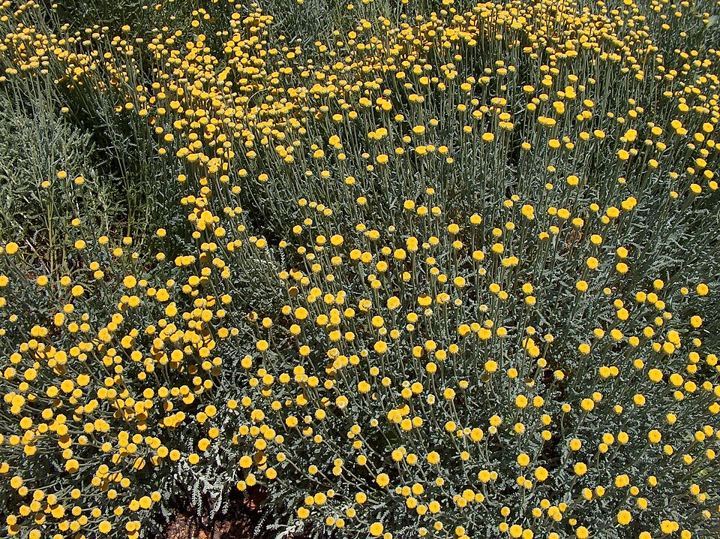
Photos
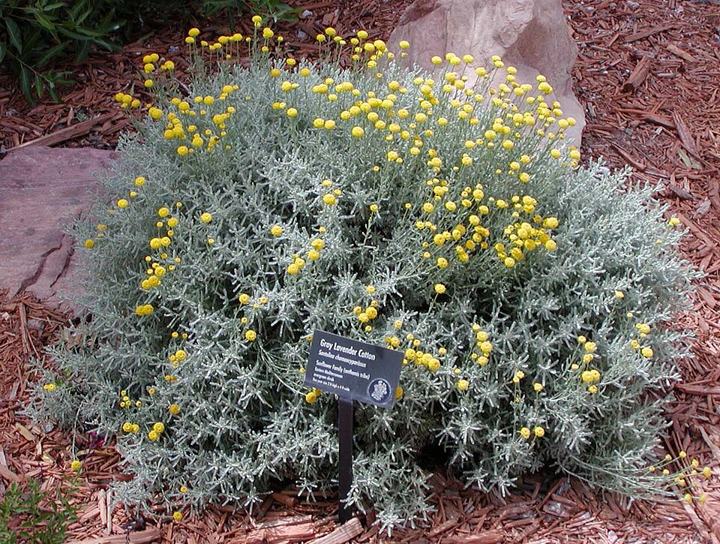
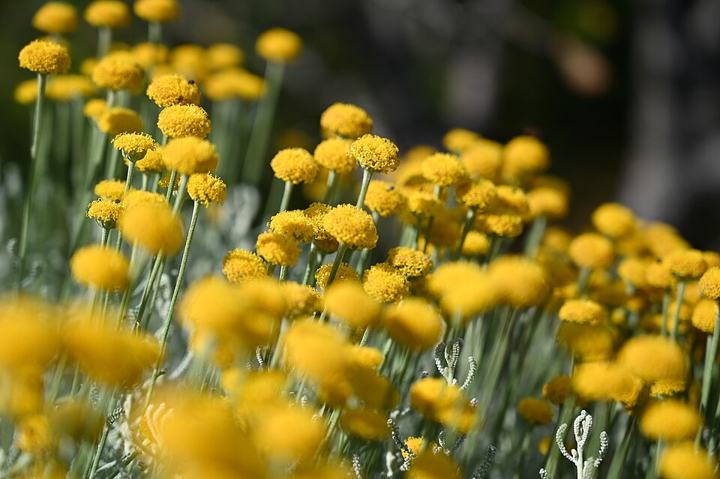
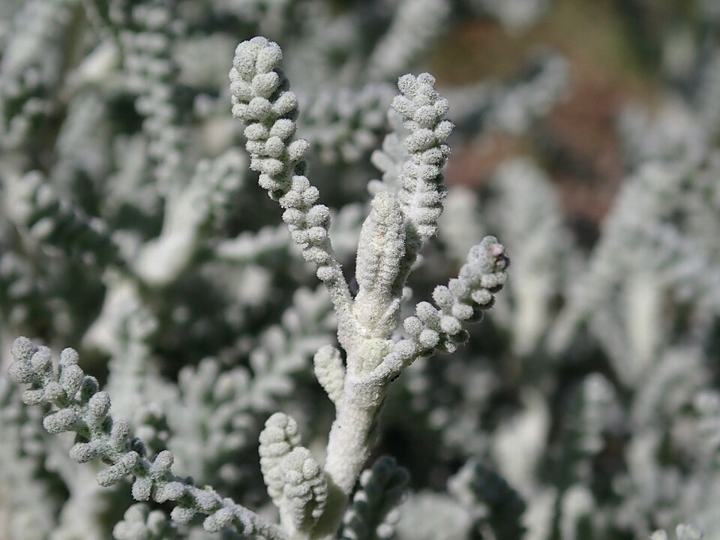
From Wikipedia
Santolina chamaecyparissus (syn. S. incana), known as cotton lavender or lavender-cotton, is a species of flowering plant in the family Asteraceae, native to the western and central Mediterranean.
Text from Wikipedia, CC BY-SA 4.0: Santolina chamaecyparissus
Description
Santolina (Santolina chamaecyparissus) is a small evergreen subshrub or shrub of the Compositae family, native to southern Europe. It reaches a height of 30 to 50 centimetres. It is very branched and dense, with a multitude of stems. The leaves are small, alternate, petiolate, elongated and divided or subdivided into rounded leaflets or pseudo-leaflets; they are covered with waxy hairs and are greyish green to silvery. The flowers form a stalked, globose head without ray florets (the elongated ones that look like petals), which is why they are often said to form a button. They are small, yellow and tubular with five lobes. The fruit is an achene. The whole plant gives off a pleasant scent.
Propagation and growing
For planting, it can be bought mainly in autumn and spring from nurseries, garden centres and specialist shops, in small to medium pots of 10 to 17 centimetres in diameter. Planting density will depend on how quickly we want to cover the ground. For borders, spacing plants every 40 centimetres works well. To create masses of foliage or ground cover, between 4 and 6 plants per square metre is best. As for soil, it is very important to avoid clay soils or soils with a lot of organic matter. It prefers very well-drained soils with a moderate level of nutrients. This is very important when combining different species in the same area, since their growing requirements must be similar for all of them to do well. Propagating Santolina chamaecyparissus is fairly simple. It can be done from seed, although commercial growers use softwood cuttings. For amateurs, the best time is late spring with softwood cuttings, and early autumn with firmer, almost woody cuttings.
Garden use
Its use in gardening is suitable in many situations, hence its popularity. For example, it is used in rockeries, to cover large areas as a grey herbaceous carpet, and to create borders separating different areas. Since it is also very drought-resistant (so watering should be rather infrequent), it is an ideal plant for xeriscaping. This species needs water only infrequently. Watering about 2–3 times a week in summer and 1–2 times a week the rest of the year is recommended. The ideal position is in outdoor gardens in full sun. The ideal time to prune Santolina in the garden, in Spain, is in autumn after flowering. Throughout the year it is always worthwhile removing faded flowers and overgrown branches as maintenance pruning. Harder pruning can be done every two years, in which case in early spring.
Source: Cabildo de Tenerife, “Guía de especies vegetales”, CC BY. Translated from Spanish by us.