
Sea grape (Zygophyllum fontanesii)
Zygophyllum fontanesii Webb & Berthel. · Family: Zygophyllaceae
A coastal plant tolerant of salt and drought, strong sun and periodic flooding by sea water. Grows on rock and sand and helps hold small dunes.
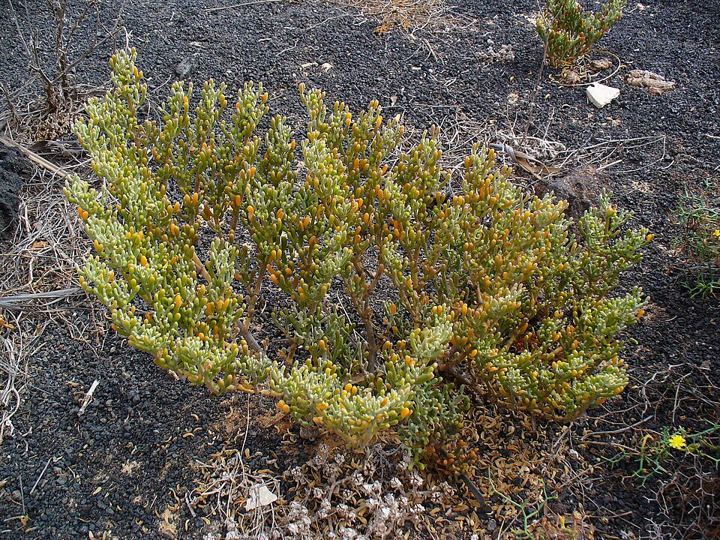
Photos
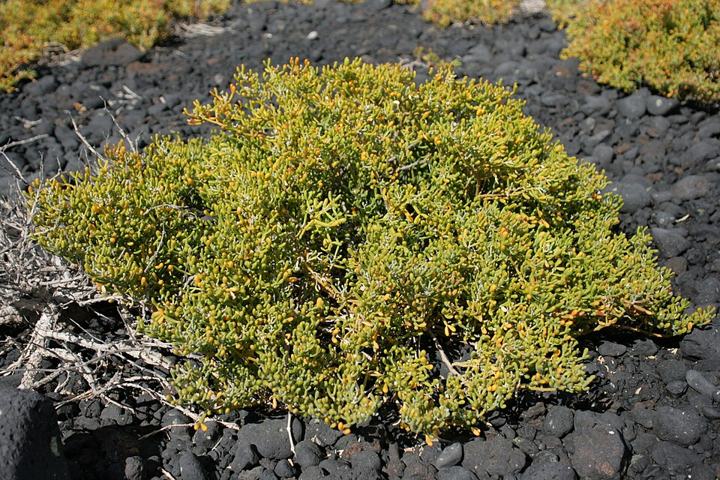
From Wikipedia
Zygophyllum fontanesii, synonym Tetraena fontanesii, is a species of plant of the family Zygophyllaceae. It is found in Macaronesia and northwest Africa.
Text from Wikipedia, CC BY-SA 4.0: Zygophyllum fontanesii
Description
A densely branched succulent shrub with a woody stem, reaching up to 50 centimetres in height. Its colour varies between green and yellow, sometimes reddish in plants in very sun-exposed areas. Its leaves are bifoliate, fleshy, cylindrical or subcylindrical. Its solitary flowers, very numerous, are small and pale pink. The capsule-type fruits grow to 5–7 mm in diameter and can easily be mistaken for leaves. The ripe, dry fruits split into five valves.
Propagation and growing
It has very good drought tolerance, but only once the plant is well established. When mature it likes sunny positions, although it tolerates partial shade. It can survive light frosts, but it is not a plant that withstands intense cold; for that reason, if it is grown in areas with hard winters, it is best to give it good protection when the cold arrives. Protection can be provided by placing it in more sheltered spots out of the cold, paying special attention to its roots. Mulching is advisable: covering the soil with a thick layer of some insulating material such as pine bark. This must be done before the soil freezes. For the above-ground part, bubble wrap or any other material that can easily be removed during the less cold hours can be used, so that the plant gets some light. Propagation is relatively easy by sowing seed and by hardwood cuttings.
Garden use
Like other plants of the Canarian coast, this is a “barrilla” (soda-producing) species, meaning that soda is obtained from its ashes, a product used in antiquity to make soap, although it was not exploited for this as much as plants of the genus Mesembryanthemum (also coastal). Its pulp has skin-healing properties and is applied as a poultice on damaged skin or small wounds. It is an edible plant, of which both the leaves and the shoots are eaten raw. Its use as food by the Canarian population has continued since ancient times, and it was very probably eaten by the ancient islanders. It does not have a high energy value, but it is rich in mineral salts of marine origin, which it accumulates internally. It also contains tannins, which tan the skin and are responsible for its wound-healing action, as well as having other beneficial health effects (curiously, discovered in wine from the grapevine, which is rich in tannins, just like our peculiar “Uva de guanche”). Although the literature does not mention its use as a fodder plant, oral sources record its use as feed for camels (Don Salvador González Alayón, goatherd from Cañada Verde, south of Tenerife), though not for goats. It does not need much maintenance, requires little water and needs medium-to-high exposure to sunlight.
Protection status
Annex II of the Order of 20 February 1991 on the protection of wild flora of the Canary Islands.
Potential vegetation
Matorrales halófilos en primera línea de costa…
Source: Cabildo de Tenerife, “Guía de especies vegetales”, CC BY. Translated from Spanish by us.
Districts
Teno · South-west · Abona